
Document Approval Before Sharing: How to Secure Sensitive Files
Enterprises regularly exchange contracts, customer records, financial reports, and confidential business documents with external partners. However, employees who have access to a file may not have the authorized to distribute it.
Document approval before sharing introduces an additional security checkpoint by ensuring sensitive files receive proper authorization before distribution. Combined with content inspection and automated workflows, this approach helps organizations reduce unauthorized sharing without slowing down routine collaboration.
What is Document Approval Before Sharing?
Document approval before sharing is a process that requires authorization before specific files can be distributed.
Unlike traditional file permissions, which determine who can access or modify a document, sharing approval evaluates whether a particular distribution request should proceed.
Approval decisions may consider:
- Document content: Sensitive personal, proprietary, or financial information.
- Classification labels: Confidentiality and sensitivity classifications.
- Sharing policies: Organizational rules governing document distribution.
- Recipient context: Internal users, external partners, or third parties.
These factors allow organizations to implement approval requirements based on the risk of each sharing activity.
Why Document Approval Before Sharing Matters
Traditional file-sharing permissions don’t always provide sufficient control over how authorized users distribute information.
For example, a finance employee may legally have access to client financial records but may still need to obtain approval before sharing them with an external consultant.
Without an appropriate approval process, organizations face the following risks:
- Unauthorized distribution: Sensitive documents leaving the organization without authorization.
- Inconsistent controls: Different departments applying different sharing practices.
- Accidental exposure: Confidential information reaching unintended recipients.
- Limited accountability: Insufficient visibility into who authorized document distribution.
Approval controls help close the gap between permission to access information and authorization to share it.
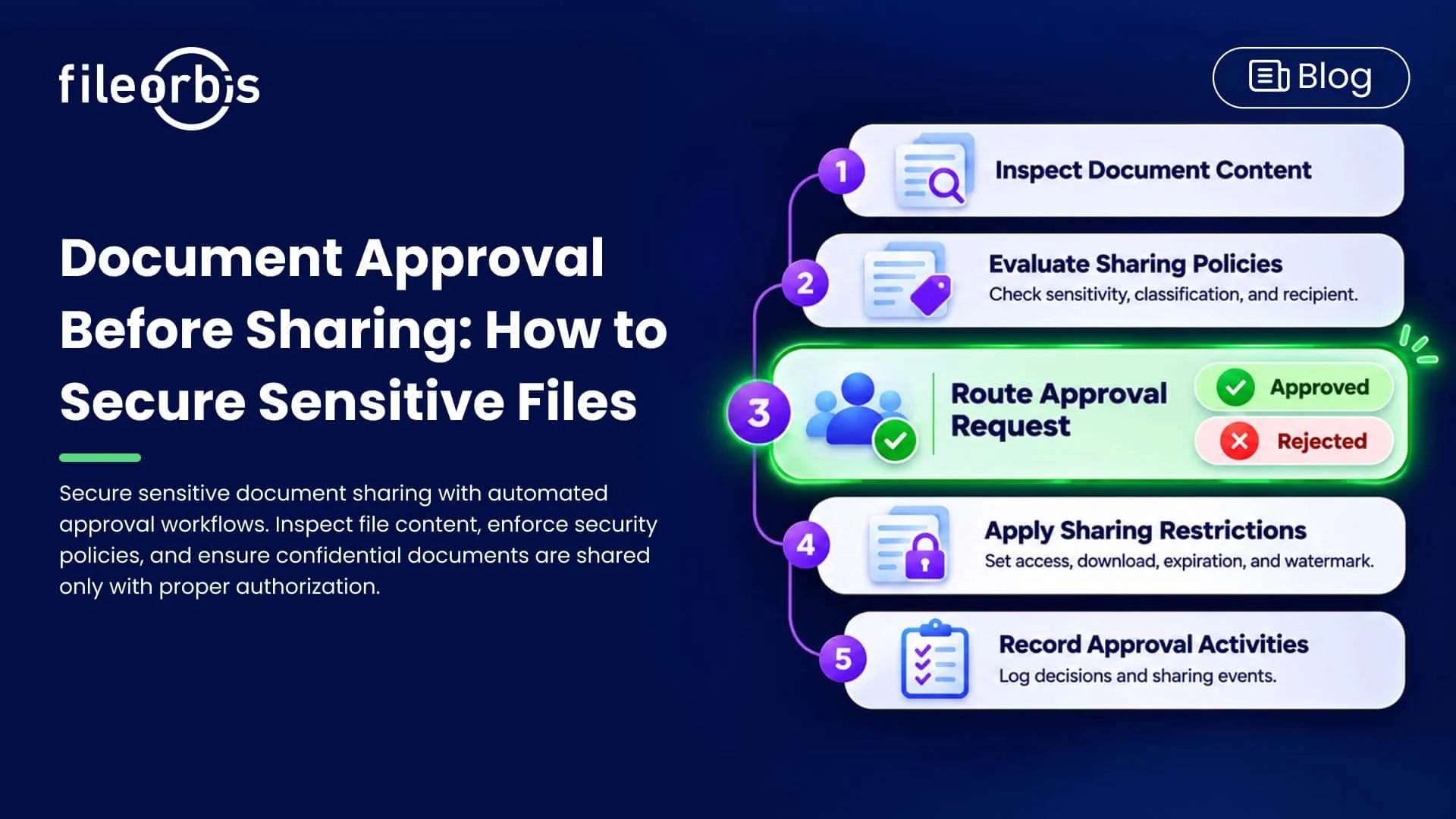
How an Automated Document Approval Workflow Works
An automated document approval workflow evaluates file sharing requests against predefined policies and decides whether authorization is required.
Inspect Document Content
Content inspection identifies sensitive information such as personally identifiable information (PII), intellectual property, financial data, or regulated records.
Evaluating Sharing Policies
The system considers document sensitivity, classification, and recipient context when deciding whether to allow, block, or send for approval a shared document.
Routing Approval Requests
Requests requiring authorization are sent to designated reviewers, including document holders, department managers, or compliance teams. Highly sensitive documents may require multiple levels of approval.
Apply Sharing Restrictions
Approved documents may be distributed with appropriate controls, including:
- Recipient-specific permissions
- View-only access
- Download restrictions
- Expired or revocable links
- Watermarking
Recording Approval Processes
Approval decisions, reviewer actions, and related sharing events are recorded to support investigations, accountability, and compliance audits.
Common Use Cases for Document Approval Before Sharing
Approval workflows are particularly valuable when employees exchange confidential or regulated information.
- Legal Departments: Contracts, litigation materials, and privileged information.
- Human Resources: Employee records, personnel documents, compensation details.
- Financial Services: Customer financial records, confidential banking documents, and transaction reports.
- Research and Development: Product designs, technical specifications, and proprietary research.
- Healthcare: Documents containing protected health information.
Organizations may establish different approval requirements for each category based on business needs and security policies.
How FileOrbis Helps
FileOrbis Content Aware Sharing enables enterprises to enforce document sharing policies based on file content, classification, and organizational security requirements.
Its capabilities include:
- Content Inspection and Classification: Identify sensitive information and use existing classification labels, including Microsoft Purview, Titus, and MIP.
- Policy-Based Enforcement: Allow, block, watermark, mask, or require approval according to defined security policies.
- Automated Approval Workflows: Route sensitive sharing requests to designated reviewers and support multi-level authorization.
- Secure External Sharing: Enforce recipient restrictions, expired links, and access revocation.
- Audit Logging: Record approval decisions and related document sharing activities.
FileOrbis integrates with existing file servers, NAS, and hybrid storage environments, helping organizations introduce controlled sharing workflows without moving data.
Learn more about Content Aware Sharing
In Summary
Document approval before sharing helps enterprises control the distribution of sensitive files without creating unnecessary barriers to collaboration.
By combining content-aware moderation, policy-based sharing controls, and automated authorization, organizations can strengthen security and accountability in their enterprises file environments.
Frequently Asked Questions
Does every document need to be approved before sharing?
No. Risk-based policies allow organizations to require approval for sensitive documents while also permitting routine and low-risk sharing.
Can document approval workflows be automated?
Yes. Automated workflows can inspect document content, evaluate sharing policies, and route sensitive requests to designated reviewers for authorization.
How does FileOrbis help secure document approval before sharing?
FileOrbis combines content-aware inspection, policy-based controls, and automated approval workflows to secure document sharing across existing enterprise file environments without requiring data migration.

Hammam Abunaser
Sales Director, MEA
Subscribe to our Newsletter
About FileOrbis
Aiming to manage the user and file relationship within an institutional framework, FileOrbis is constantly being developed in order to meet different industry and customer needs in terms of file management and sharing. Since 2018, FileOrbis continues to be developed with the excitement of the first day. FileOrbis focuses on high security, rich integration, ease of use and integrated management criteria.